Sunday, April 23, 2023

Nintendo Playing Cards catalogue from 1975

From their earliest beginnings well over a century ago, up until the present day, Nintendo has continuously been updating its range of playing cards, responding to trends and changes in customer taste, to sales successes and failures, as well as to new ideas by competitors.

Sales material provides great snapshots of what was available at a specific point in time. In today's post, we will take a look at Nintendo's offering presented in this Playing Cards catalogue from the mid 1970s.

The full-colour brochure is printed on heavy glossy paper. The publication date was July 1975.


Nintendo Playing Cards catalogue (front and back)

It is a single sheet, that has two folds to create six pages in total. When folded close, it is about A4 in size.


Nintendo Playing Cards catalogue (inside)

The image on the front shows a little porcelain statue of a couple playing music and singing. It would have been more appropriate if they had been playing cards, but the feeling of playful social interaction and style is portrayed well.

The top of the line products are shown underneath, with the most luxurious package version (with product code NAP 1505) taking centre stage.

The font used and the lily flower symbol print on the table cloth all add to the sophisticated, classic look they were clearly going for. The visual message: this is is not about toys, but serious fun for adults.

Most of the card decks included in the brochure are variations of the typical graphic, geometrical card back designs.

Sunday, April 2, 2023

Nintendo Mini Game Series leaflet (ca 1975)

The Mini Game Series (ミニゲームシリーズ) was a collection of around fifty simple plastic toys, brought to market by Nintendo in the first half of the 1970s (roughly 1971 to 1976). The series covered a wide variety of play options, with prices for each toy ranging between ¥300 and ¥900.


A selection of Nintendo Mini Games (1970s)

In today's blog post we will take a look at this piece of marketing material targeted at toy dealers and distributors.


Nintendo Mini Game Series leaflet
(ca 1975, front)

It's a single page leaflet, printed on both sides in colour. It measures 18 by 25.5 centimeters, slightly smaller than A4.


Nintendo Mini Game Series leaflet
(ca 1975, back)

The leaflet dates from around 1975. The 'new release' (新発売) claimed in the top left corner of the front is a bit of a stretch, as most of the series was already a few years old at the time, although it may refer to some of the individual new(er) games.

Saturday, April 1, 2023

Nintendo playing cards price increase in 1976

The 1973 / 1974 global oil crisis hit the Japanese economy relatively hard, because of the country's large dependency on foreign energy, mainly in the form of oil. The resulting increasing energy cost caused a strong inflation that echoed on for years.

Like so many other Japanese manufacturers, Nintendo was forced to increase the prices for its products, as we can see in the message below called "guide to partial price revision of playing cards", date December 20th 1975.

The one-sided printed memo measures 18 by 25 centimeters.


Message from Nintendo to Distributors
(December 20 1975)

The message reads:

"Dear Distributor,

We would like to express our sincere gratitude for your continued patronage.

Now, due to the increase in raw materials and processing costs for playing cards, we have decided to revise the following prices for playing cards from January 21, 1976.

In any case, I would like to ask for your understanding and understanding of the circumstances."

This is followed by a table in which the changes are outlined.

Three types of cards are included in the price increase:

  • Disney playing cards (ディズニートランプ)
  • Ado playing cards (亜土 トランプ)
  • Girl playing cards (少女 トランプ)

The 'Ado' cards are designed by famous illustrator Ado Mizumori (水森亜土).

Examples of the three types of effected cards are shown below, taken from a Nintendo product catalogue from July 1975, published a few month before the price change announcement.

For all three types the price is increased from 500 円 to 600 円, a steep 20% increase.

Friday, March 31, 2023

Hiroshima 1929 expo booklet with Nintendo ad

Today we will take a look at the booklet shown below, which is almost a century old. Inside we will discover a nice little nugget of Nintendo history.

The booklet is roughly B6 size (132 by 190 mm), contains 128 black and white printed pages, a color pullout and a color printed front and back.

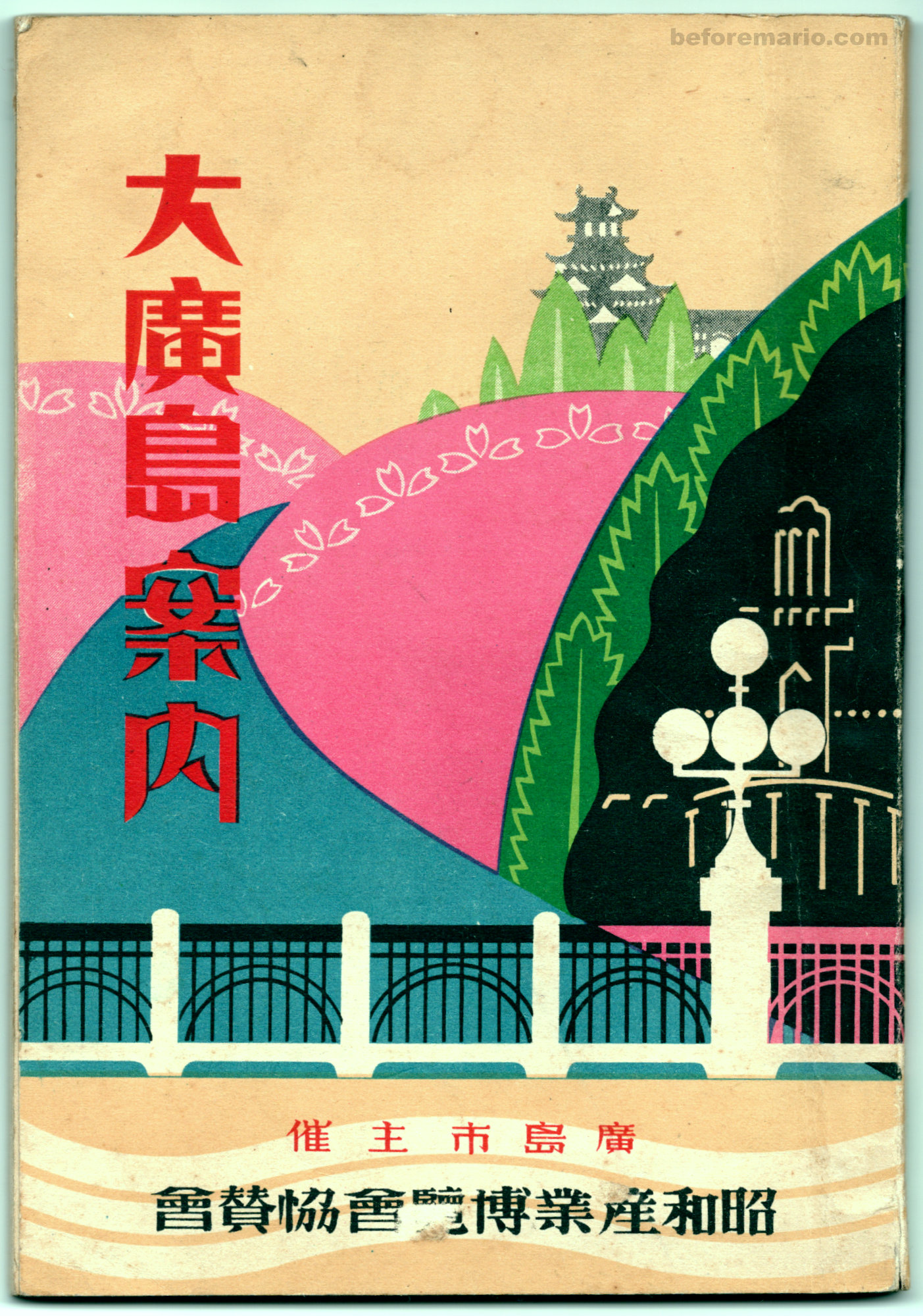
The title is Great Hiroshima Guide (大廣島案内), which is printed in large red kanji on the front.

The sub title reads Showa Industry Expo Conference (昭和產業博覽會恊贊會), which is sponsored by Hiroshima City (廣島市主催).

As an aside, for those of you not familiar with the changes over time to the writing style of Japanese script, this booklet stems from an era when the custom was to write top-to-bottom and right-to-left.

Great Hiroshima Guide (1929) front page

The drawing on the front shows various landmarks of the city of Hiroshima, including Hiroshima Castle.

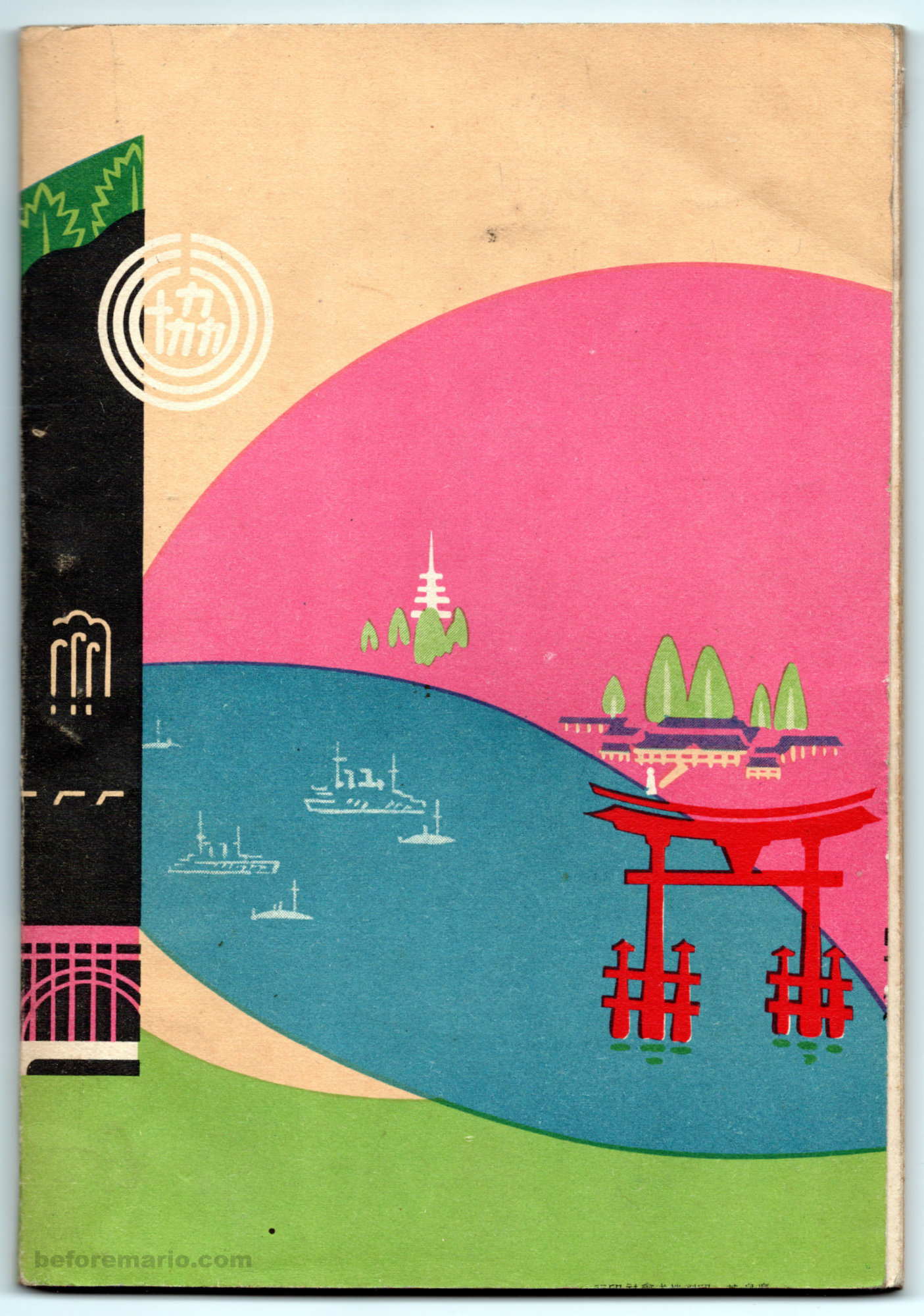
On the back we immediately recognize the Itsukushima shrine, located at the shoreline of the nearby Itsukushima island (also known as Miyajima).


Great Hiroshima Guide (1929) back page

The colofon at the back of the booklet indicates that it was printed in March of 1929. That is 94 years ago!

It also states that the booklet was not for sale (非売品).

The booklet was commissioned by the city of Hiroshima, in cooperation with the "Showa Industry Expo Association" (昭和產業博覽會恊賛會), and presumably handed out for free to (prospective) visitors of the expo.

The publisher and editor was Yakichi Ishikawa (石川彌吉).


Colofon

In the preface, the editor explains that the booklet covers the main attractions ("famous places") of the city of Hiroshima and surroundings, using "as many pictures as possible". Information about shops and products is "provided by advertisements".

Indeed, besides editorial content, more than half of the booklet is filled with advertisements.


Preface

At the front of the booklet, there is a very nice pullout map, printed on one side in color. When pulled out, it measures about 46 centimeters wide.

The front of this map shows a drawn aerial view of the city of Hiroshima, with indication of the tram lines and tram stops as well as the locations of the expo. The back shows a map of the greater Hiroshima area, with all railway connections.