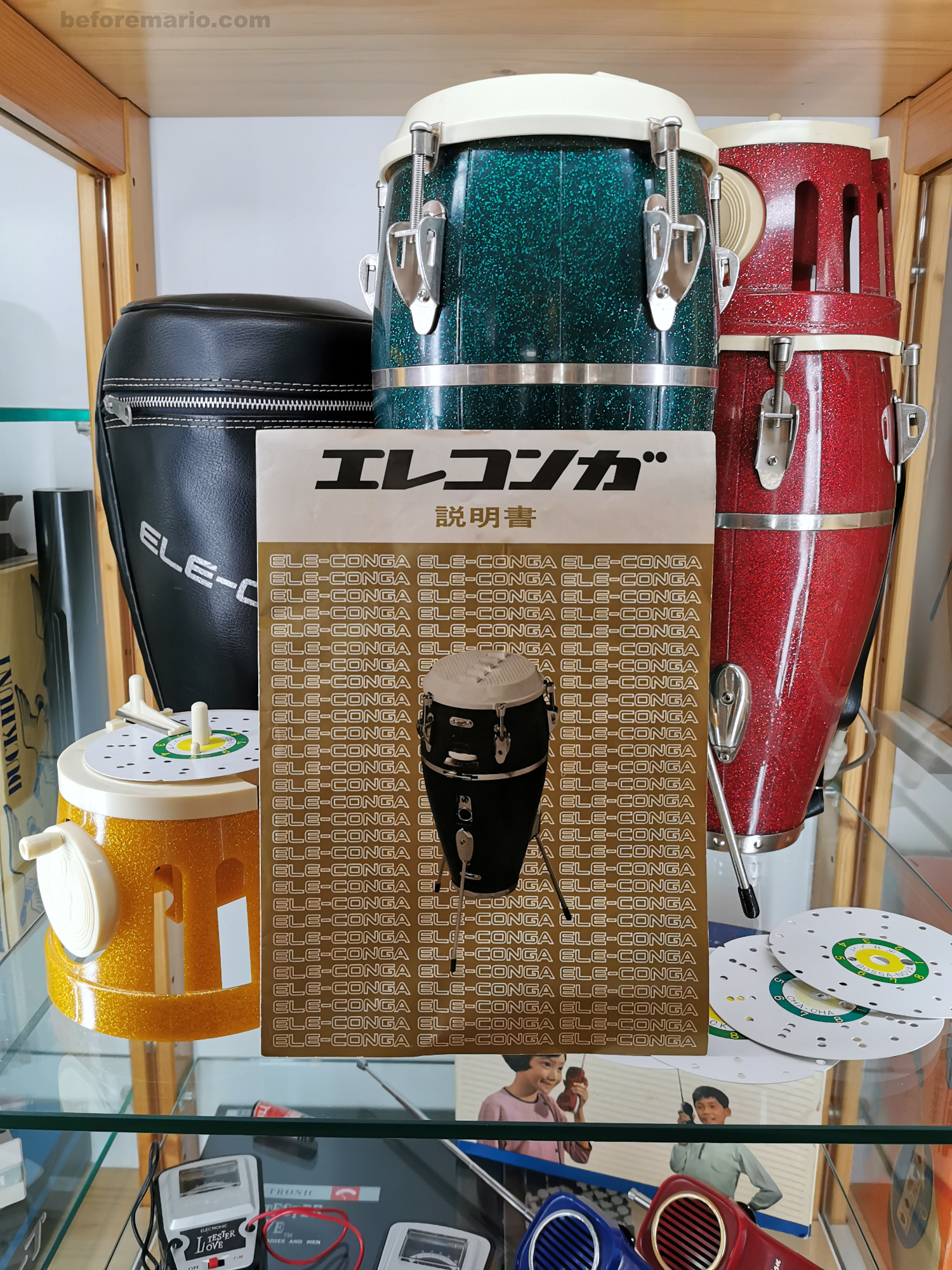
The Ele-conga (エレコンガ) is an electronic percussion instrument, created by Nintendo and released in 1972. It offers five different analogue sounds: Snare, Maracas, Claps, High Congas and Low Congas.
I recently came into contact with Forgotten Futures, an organization whose mission is "to revive lost and forgotten yet vital artifacts of electronic musical instrument history by collecting, faithfully restoring and preserving original instruments".
Nintendo Ele-conga (1972) manual front
They were interested in preserving the Ele-conga manual and I gladly provided a scan of a copy from my collection.
Nintendo Ele-conga (1972) manual inside
The document was digitally restored by Mike Buffington (his site here). I believe he did a great job, removing all stains, creases and other damage. You can see the result here.
Nintendo Ele-conga (1972) manual back
If you would like to learn more about this wonderful Nintendo item, check out this previous blog post.
One of the intriguing Nintendo products from the 1970s is the Ele-conga, an analogue electronic musical instrument.
Although not hugely expensive given its build quality (retailing at ¥9.800, which is roughly ¥30.000 in todays money when corrected for inflation), it was intended to be a serious instrument, not a toy.
That Nintendo was aiming for this to be an item for adults, is evident from the photo on the front of the promotional leaflet. It shows a trio of grown-ups making music with two Ele-congas, accompanied by an acoustic guitar.
Ele-conga Leaflet (front and back)
On the back of this leaflet, three accessories are listed, that were sold separately as options:
Auto Player (available for an additional ¥1.200)
Connector Cord (¥500)
Soft Case (¥1.000)
The Auto Player (オートプレーヤー), pictured in the left-bottom corner of the back of the leaflet, allowed for programmed rhythms to be repeated (semi) automatically.
Although the Ele-conga includes its own speaker, it was possible to connect it to the line-in of a music center or tape deck, for external amplification or recording. The Connector Cord (コネクタコード) was a two-meter long cable that provided the required connection, using standard 3.5 mm jacks.
While pretty rare today, both the Ele-conga and Auto Player can be found as second hand items in Japan, if you know where to look and show some patience and perseverance.
An official Ele-conga Connector Cord, I have never seen in real life, though I still hope to find one, one day. As is often the case, accessories such as these are very hard to find, as they were sold in (much) smaller numbers than the Ele-conga itself. They also got misplaced or lost more easily, or no longer recognised for what they were, and thrown out.
Ele-conga options (accessories): Auto Player, Connector Cord and Soft Case
For many years, the Soft Case (ソフトケース) also remained only an option listed on a piece of paper. As no picture was included on the leaflet, and none of these appeared in collector circles, it was not clear what this case looked like, or if it was actually produced and sold at all.
This changed recently, when one of these showed up at last.
So presented here in its full glory: an original Ele-conga Soft Case from 1972!
How does the Nintendo Ele-conga sound? That's a question I have been asked a number of times over the years. Multiple musicians also expressed an interest to use these vintage 1970s sounds in their music.
Nintendo Ele-conga (1972)
The Ele-conga, for those of you not yet familiar with this piece of Nintendo history, is one of the many brain-childs of Gunpei Yokoi. It's an electronic drum machine, with analog circuitry. It can produce five different percussion sounds. With the Autoplayer accessory, it can play pre-programmed rhythms.
Nintendo Ele-conga and Autoplayer
Well, for all folks interested to hear an actual Ele-conga play, your prayers have just been heard.
In the early 70s, Nintendo had not yet decided to focus on (electronic) toys and games only. They were still branching into various markets, trying their luck in areas as diverse as office supplies (Uni-rack storage system, Copylas photocopier), home appliances (Candy Machine for candy floss at home) and baby gear (Mamaberica stroller and Twins seesaw).
Most of these ventures had limited success, and did not see more than one or two products per category.
The Ele-Conga (エレコンガ) is another example of this: an electronic drum machine which was more serious musical instrument than toy.
Nintendo Ele-Conga
The Ele-Conga was released in 1972 and retailed for ¥9,800. It has product code "ECG".
The Ele-Conga (short for Electronic Conga) was another invention involving resident engineer and inventor Gunpei Yokoi. It shows Nintendo getting to grips with increasingly complex electronic products (following the Love Tester, Kousenjuu light beam series and the Light Telephone).
Ele-Conga Manual
The Ele-Conga came with three removable legs and a carry strap.
A pretty power-hungry animal, the Ele-Conga required no less than eight batteries to operate: 6 C cells and 2 AA batteries. Thankfully, as is customary for most products sold in Japan, the batteries were included. The bottom of the Ele-Conga needs to be removed to insert the batteries.
When switched on, the Ele-Conga can produce five different electronically generated (analogue) drum sounds. Each of the five buttons on the top represent a single sound. Multiple buttons can be pressed at the same time.
The speaker is located just below the buttons on the top.
The five sounds the Ele-Conga can produce are: (S) Snare, (M) Maracas, (C) Claps, (HC) High Congas and (LC) Low Congas.
The manual includes a number of rhythm patters that can be played with the Ele-Conga, showing which buttons to press to produce a Mambo or Cha-Cha.
Rhythm patters are provided on the back of the manual
On the side of the Ele-Conga, you can find a volume dial and a line-out to connect the Ele-Conga to an external amplifier.
The bottom connector allows the Ele-Conga to be connected to the Autoplayer: a clever accessory for people who are somewhat rhythmically challenged.
Ele-Conga Autoplayer manual
The Autoplayer (アートプレーヤー) was sold separately for ¥1,200. It has product code "ECG-MX".
Ele-Conga advertisement: Latin Rhythms for ages 10 and up
Ele-Conga Autoplayer
The Autoplayer set includes the Autoplayer itself, eight programmed rhythm discs, ten blank rhythm discs and a hole puncher.
Ele-Conga Autoplayer set, including rhythm discs
When using the Autoplayer, it was no longer necessary to press the buttons of the Ele-Conga at the right time to produce a rhythm. The Autoplayer would do this for you.
Ele-Conga Autoplayer manual
The Autoplayer has a dial on the side, which is used to turn the rhythm disc placed on the top.
The rhythm discs work simliar to old fashed computer punch cards. On the left side of the top of the Autoplayer, you can see five contacts. The holes in the discs contain the rhytm pattern to be played. If a hole in the rhythm disc passes one of these contacts, the corresponding sound would be played by the Ele-Conga.
The eight rhythm discs that came with the Autoplayer include: Beguine, Bossa-Nova, Cha-Cha, Chindon-Ya (a Japanese March), Mambo, Rhumba, Rock and Samba.
Two of the eight rhythm discs that came with the Autoplayer
By turning the dial of the Autoplayer by hand, the Ele-Conga would produce the rhythm programmed into the disc.
I mentioned this was an accessory for the somewhat less musical, but it still requires the dial to be turned at a steady pace to produce a tight beat.
It is also possible to create your own rhythm discs for the Autoplayer.
The manual explains how to create your own rhythm pattern
You create your own rhythm disc by punching the desired holes in one of the blank discs, using the provided hole puncher.
Blank rhythm disc for the Ele-Conga Autoplayer, with hole puncher
The Autoplayer's cable is connected to Ele-Conga, using the port on the side of the Ele-Conga.
Ele-Conga and Autoplayer
The bottom of the Autoplayer fits neatly on the top of the Ele-Conga.
Combining Ele-Conga and Autoplayer into a single instrument
The Ele-Conga was produced in three colors: yellow, red and green.
All three Ele-Conga colors
The Autoplayer also came in matching yellow, red and green. However, every color combination of Ele-Conga and Autoplayer works just as well.
All three Autoplayer colors
The Ele-Conga was a high-quality product and quite advanced for its time, given that drum machines had only become available to a more mainstream audience as part of organs in the 60s.
You can see it in action in the video below. And you can hear and download the sounds here.
Besides the N&B Block Ringer, the Ele-Conga would remain Nintendo's only endeavor into the music business. Well, that is, if you do not count Wii Music.
The entire Ele-Conga family
[2020 Update] I further expanded my Ele-conga collection, when I added the original carry Soft Case, which was sold separately as an option.