Showing posts with label Game and Watch. Show all posts

Tuesday, December 31, 2013

Was this the idea for Game & Watch Octopus?

Through blog reader Eric Ash, I was pointed to an intriguing board game, made in the USA in the 1950s.

To fans of the Nintendo Game & Watch series, it looks very familiar. It raises the question if this board game was the inspiration for the Wide Screen Game & Watch Octopus.

Octopus board game by Norton Games of New York (1954)

It all seems to match: the title (obviously), as well as the game's objective (prying bounty from an octopus protecting a treasure chest) and the board layout (with a cross section of the sea).


Friday, December 27, 2013

New Game & Watch collectors guide

A few days ago, a new Game & Watch book was released by Austrian duo David Gschmeidler and Gerhard Meyer. The book is called Der Inofficielle Game & Watch Sammer-Katalog (The unofficial Game & Watch Collectior-Catalogue), and - as this title kinda gives away - the book is written in German.

Authors Gerhard Meyer and David Gschmeidler

For folks who master the German language, or otherwise want it anyway, the book is currently available in a regular and limited edition on the authors website www.gameandwatch.at.

Update: An English version now also available here.

Regular and limited edition

It looks like an informative book for collectors. You can expect a full review here soon.

David also participated in our Meet the Collectors series.

Saturday, June 22, 2013

How the Bassmate Computer came to be

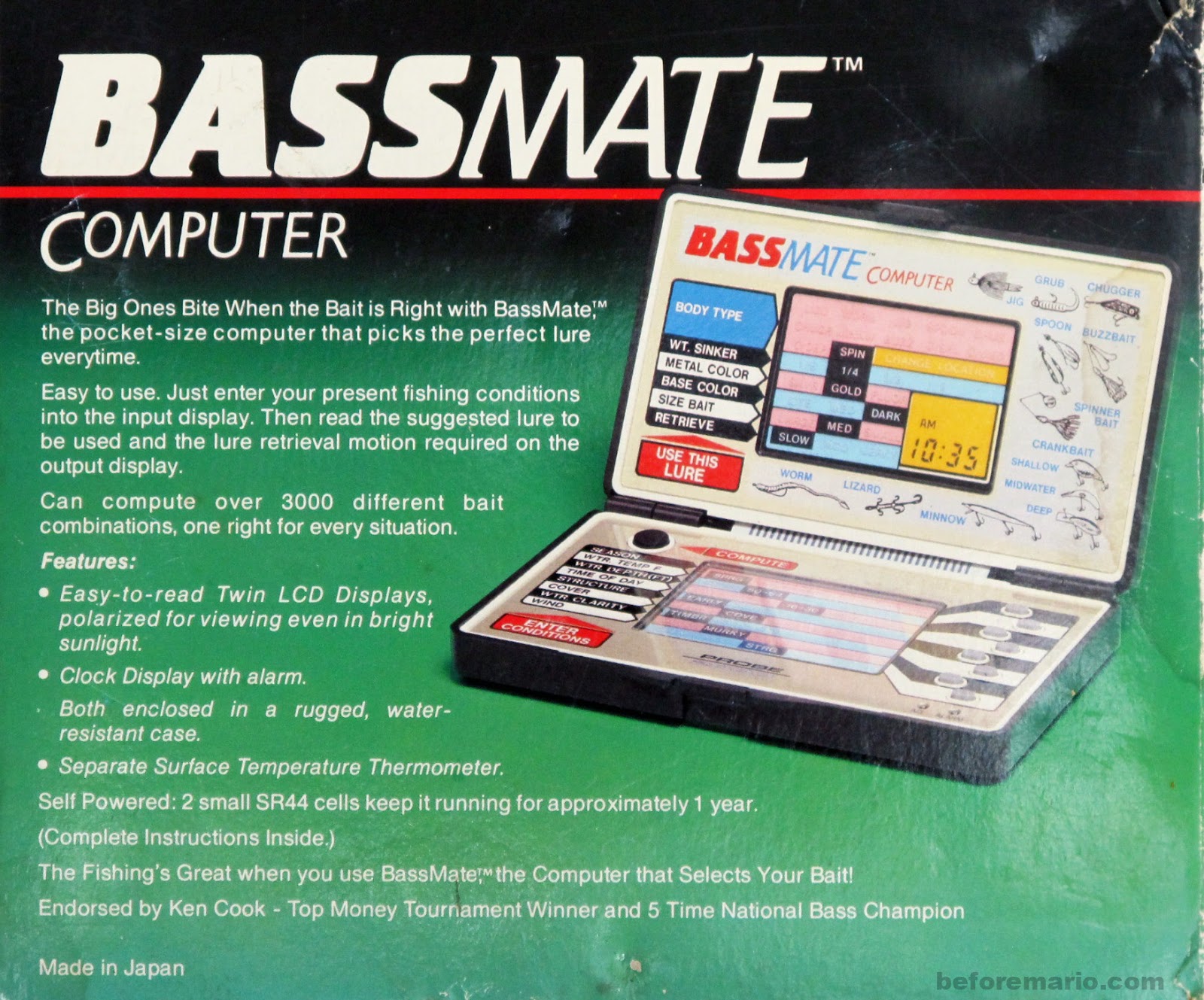
In the previous post, we introduced the Bassmate Computer; a pocket electronic databank from 1984, targeted at bass fishers. The Bassmate was manufactured by Nintendo and co-designed by the Game & Watch team from Gunpei Yokoi's R&D1 department.

Bassmate Computer by Telko / Probe 2000 / KMV (1984)

American engineer Bill Olliges was the inventor of the Bassmate. He conceived it together with his business partner Ed Miller, who took care of the marketing through his company Telko.

In an earlier stage of his career, Bill was involved in the American arcade business, as was Ed. In the late 1970s and early 1980s, they both worked as executives for the American devision of Taito and later for Florida based Centuri inc.

During its heyday, Centuri was one of the top US suppliers of video arcade games. Many of their machines where licensed from Japanese companies, in particular Konami. The list of games they manufactured and distributed includes hits like Phoenix, Vanguard, Track & Field, Time Pilot and Gyruss.

After the demise of the video arcade industry in the mid 1980s, Bill started an engineering firm called Proton Engineering, which he is still involved in today. 

[Update: Almost five years after the first publication of this story, Bill Olliges passed away in February of 2018].
 
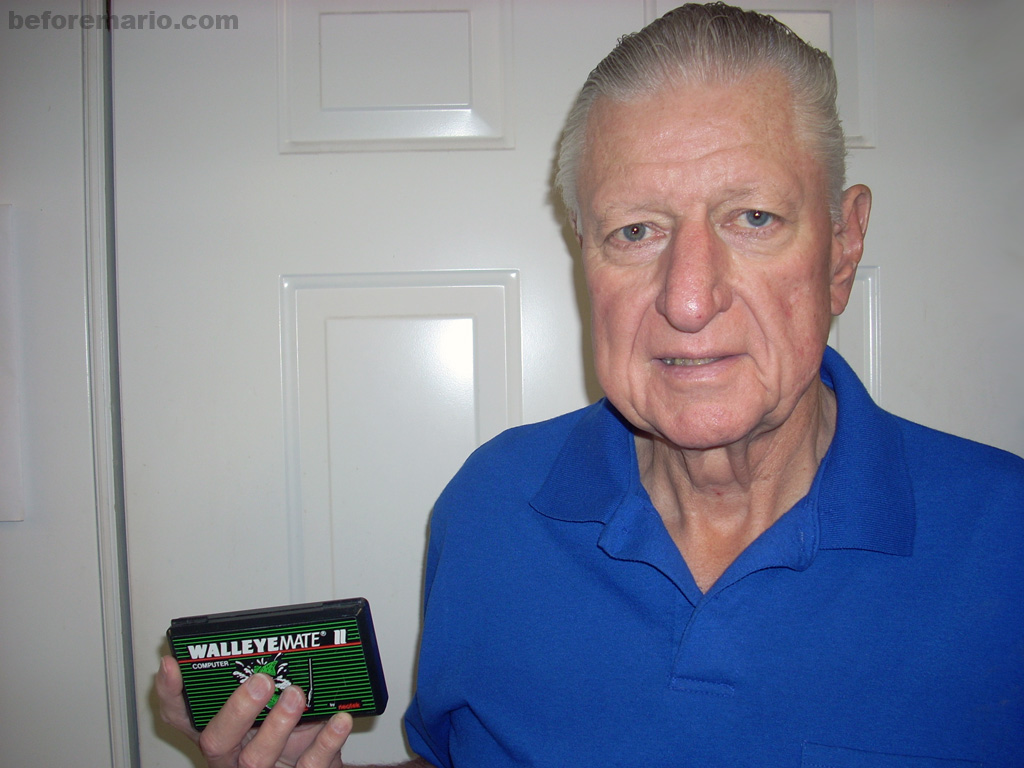
Bill Olliges holding a WalleyeMate II, one of the products
that was created after the success of the Bassmate

Bill explains where the idea for a fishing computer came from and how Nintendo got involved.

Wednesday, June 19, 2013

Bassmate Computer (1984): a newly discovered member of the Game & Watch family tree

Chances are high that you have never heard of Game & Watch BM-501. I had never heard of it myself, until a few weeks ago, when fellow Nintendo collector Sander mentioned that I should take a look at the Bassmate Computer; a pocket size electronic device that helps select the best lure and bait combination for every bass fishing condition. Sander had spotted it during one of his regular searches on eBay.


The Bassmate I saw was sold under the name of a brand called "Probe 2000" and dated from 1984. At first glance, it seemed like a regular sporting aid, be it one that was quite advanced for its time.

However, when checking out the image on the back of the box, something dawned on me. That shape seemed rather familiar! It looked just like a Game & Watch Multi Screen!


When taking a closer look, it appeared that everything matched; the overall design of the case, the hinges, the connector between the bottom and top part, the shape of the buttons - they all looked like they came straight out of the kitchen of the handheld master from Kyoto.

Sunday, May 6, 2012

Nintendo Game & Watch Multi Screen (ゲーム&ウォッチ マルチスクリーン, 1982-83)

Yesterday's post on my second ever Nintendo game (Game & Watch Mario Bros.) got me so excited about these great little handhelds, that I decided to continue with this topic.

Nintendo Game & Watch Multi Screen Mario Bros., Rain Shower and Lifeboat

The first two Game & Watch Multi Screen games (Oil Panic and Donkey kong) were released close to each other in May and June of 1982.

[Video uploaded by Youtube user ksoik]

Two more were released at the end of 1982, just in time for Christmas: Mickey & Donald and Greenhouse.

[Video uploaded by Youtube user ksoik]

Donkey & Kong II followed in March of 1982, bringing the total to five.

Saturday, May 5, 2012

My second Nintendo game - Mario Bros.

The other week I told you about my first, ever Nintendo game I owned. Now, a single item obviously can't be called a collection. But two, that is starting to look like something.

My second Nintendo purchase, which I bought in the Summer of 1983, was Game & Watch Mario Bros.

My collection artefact #2 - Game & Watch Mario Bros. (1983)

Where the ColecoVision Donkey Kong cartridge was cool because it provided an approximation of the arcade experience at home, in a way this one was even more special, as it delivered a totally new experience for me: portable electronic gaming.

Without knowing it at the time, these two items where my introduction to the genius work of both Gunpei Yokoi and Shigeru Miyamoto. The former as the creator of Game & Watch, and the latter as the father of Mario.

Sunday, January 15, 2012

Nintendo Color Screen (Game and Watch Table Top) - Leaflet

The most spectacular games in the Nintendo Game & Watch series are the Panorama and Table Top games. Combining the excellent LCD based game-play that shines throughout the entire series with full color images, these were innovative as well as fun to play.

The Table Top games were shaped like mini arcade cabinets, with joystick and all. In the 80s, owning one of these must have been close to being in handheld nirvana.

Nintendo Color Screen (a.k.a. Table Top) from 1983

The original name under which these games were sold in Japan was Color Screen (カラースクリーン), with strangely enough no reference to Game & Watch, although they are clearly part of that family. They were introduced in the rest of the world as Game & Watch Table Top.