Showing posts sorted by relevance for query company guide. Sort by date Show all posts

Friday, May 14, 2021

Nintendo company guides overview 1999-2020

Over the last twenty years, Nintendo has released a new company guide (almost) every year. These are well designed booklets about what goes on inside the Nintendo headquarters in Japan, with a lot of information and many pictures, most of which are exclusively shared in these guides. They provide an unique insight into what it is like to work at Nintendo.

In the past, I have covered a few of these company guides on this blog, and I intent to share the others as well. This overview page functions as an easy place to access these posts.

Company profiles 1993 and 1998

These two company profiles are sort of precursors of the company guides. Aimed at investors rather than employees, the are somewhat simliar in content to the company guides below, although they showcase mostly released products rather than behind the scenes stuff.

A detailed post about the 1993 company profile can be found here, and 1998 will follow later.

Company guide 1999

The first of the (known) company guides created for prospective employees was released in 1999.

More details coming (hopefully) later. If you have one of these for sale, I would love to hear from you.

Company guide 2000

More details coming (hopefully) later. If you have one of these for sale, I would love to hear from you.

Company guide 2003

After a hiatus of two years, in which no comopny guides were released, a new one appeared in 2003.

More details coming (hopefully) later. If you have one of these for sale, I would love to hear from you.

Company guide 2004

More details coming.

Saturday, May 9, 2015

Nintendo's 2015 company guide is a visual celebration of its past and present

In previous posts we have looked at various editions of Nintendo's company guide (see bottom of this post for a list). This guide is completely redesigned yearly and used by Nintendo in Japan to introduce the company to new employees. It is distributed to job applicants who take part in the yearly recruitment process at the start of the fiscal year (in April).

These guides are very interesting for Nintendo enthusiasts, as they provide a peek behind the white stone facades of the usually very closed corporation. The content focusses primarily on present achievements (recent game hardware and software) and the company's strategy for the future.

However, the guides also provide information on the company's history. Nintendo was founded over 125 years ago, and its long and rich heritage must surely be an important reason why young people choose to apply for a job at Nintendo.


The interest for the company's history seems to be growing lately, outside of company as well as within Nintendo. In recent years, these guides have also paid increasing attention to the company's past.

A few years ago, the history was dealt with in just one or two pages with a list of products and events. But the last two editions give it a much more prominent place.

Last year's guide was designed in the style of hanafuda cards Nintendo's first product that started the company back in 1889. And this year's guide even tops the previous one with even more extensive content that provides a fantastic visual celebration of Nintendo's present as as well as its past.

Nintendo company guide 2015 - cover sleeve

The guide comes in a very colorful cardboard sleeve. This sleeve is covered on both sides in many of the different versions of the Nintendo logo that the company has used over the years.

The front and back of the guide itself are also full of logos, printed in beautiful silver ink on a black background.

Saturday, May 3, 2014

A closer look at Nintendo's 2014 company guide

A few weeks ago, in the post about the beautiful 2013 Nintendo company guide for recruits and new employees, I promised to also show the 2014 edition in more detail. Well, here it is.


The 2014 edition is a hardcover book with 64 pages, printed on high quality paper. It measures about 18 by 28 centimeters.

This edition is designed like a pack of Nintendo hanafuda cards. Hanafuda are the traditional Japanese playing cards that use images representing nature in various stages across the twelve months.


The first section of the guide has a lovely pictorial of some of Nintendo's major products from its long history. It is clearly important to Nintendo that all of its staff are aware of this heritage.


The first product are the hanafuda (花札) cards, or 'flower' cards, which started the company in 1889. The one card shown is the full moon card from the August suit. Like all Hanafuda cards, it includes a flower or plant, and this one depicts Susuki grass (薄), waving in a nightly breeze.

Sunday, November 9, 2014

Nintendo takes to the air in its 2012 company guide

The Nintendo company guide from 2012, presented to new (prospective) employees in Japan, does a nice job visualizing the global impact they can expect to have, as their creations will travel the world.

Captain Mario - heading the Nintendo air fleet

Mario is presented on the front, sporting a captain suit of the imaginary NTD Airlines. It is not often that you see Mario in suit and tie, but he wears it well.


The book measures 30 by 20 centimeters and has 64 pages. Underneath the dust jacket, the book's front and back covers are decorated with nice art from (then) recent games.


The air travel theme is carried out throughout most of the book, starting with a page with some great fantasy airport signs and luggage labels.


The first part of the book contains a visual story of around ten pages, with Nintendo games and figures traveling the world.

Monday, October 20, 2014

Nintendo's 2011 company guide is a treasure trove of behind the scenes pictures

The Nintendo company guides (that I posted about before, here and here), are great pieces of design work, as well as fantastic glimpses behind the white facades of Nintendo's headquarters in Japan.


These guides are given to prospective employees who participate in the yearly job application process conducted by Nintendo in Japan. The company guide shown here is from 2011.


The front shows a colorful collage of sketches of characters like Mario, Yoshi and Link.


The collages continues on the back, which more familiar faces.

Sunday, March 2, 2014

Nintendo's beautiful company guides

In today's post we will take a look at a Nintendo tradition that is somewhat shielded from the eyes of the general public.

Like most other regular businesses, Nintendo produces a company compendium for internal use, with information on history, strategy, departments and management.

Cover of this year's Nintendo company guide

But unlike most companies - that usually deliver dull affairs not unlike telephone directories dipped in some branding sauce - Nintendo's company guide is eye-poppingly well designed.

Saturday, April 5, 2014

Another beautiful Nintendo company guide

Last month I showed some pictures of the 2014 edition of the Nintendo company guide. This guide is provided to new and prospective employees. It shows the company's history and basic corporate information, and also gives a flavor of what it is like to work for Nintendo.

Nintendo company guides from 2013 and 2014

Each year, the guide is not only brought up to date, but also completely redesigned, usually around a theme. Over the years, the design has become more and more elaborate. These guides are little pieces of art, that contain behind the scenes material you do not see very often.

Recently, the edition of last year fell into my lap. This 2013 version is once again so nicely made, that I will show quite a bit of it in this post. I am sure you will enjoy this little peak behind the curtain of the wizards from Kyoto.


The somewhat surprising theme of the 2013 guide is vegetables. The front of the booklet is designed to look like the side of a cardboard box that can hold various sorts of produce. There is even a cutout in the shape of a handle.

The four kanji on the front (京都特産) stand for 'Kyoto speciality', referring to Nintendo's output as a regionally grown delicacy. Quite fitting, actually.


The booklet is 64 pages long. It starts with some pictures of vegetables and agricultural landscapes mixed with Nintendo characters and products.

Saturday, May 15, 2021

Nintendo company guide 2019

In 2019 Nintendo released another instalment in their (almost) yearly series of booklets created for prospective employees of Nintendo of Japan, sent out to people who applied for a job during the yearly hiring cycle in Spring.

After the unusual shape of the 2018 company guide, Nintendo returned to a more standard format for the 2019 guide, with some small surprises.

The booklet measures 25 by 17 centimeters. It has 64 pages. The front and back appear to be a very bland monochromatic white.

On closer inspection, and at the right angle, a Nintendo logo can be seen, printed in clear varnish. A little red bit is peeking out in the bottom corner.

This little corner is inviting you to peel off the white cover, and this reveals the actual front (and back) that shows a splurge of (some very familiar) faces. For a peek at the back, see the bottom of this post.

With some imagination, the design of this 'peel-off' cover can be seen to represent the Nintendo company and the Nintendo headquarters in Kyoto: calm, solid, but also distant and somewhat non-descriptive on the outside, and brimming with energy and excitement on the inside.

Friday, June 12, 2015

Two Nintendo enthusiasts meet in Tokyo

One of the highlights of my recent trip to japan was spending an afternoon in the company of Isao Yamazaki. Isao is one of the biggest and most knowledgeable Nintendo collectors in the world. In Japan he is considered a top expert on the history of Nintendo. And Japan being Nintendo's home turf, that is saying something.

Together with my daughter Loes, who accompanied me on this Japanese trip, I met up with Isao at Nakano station in Tokyo. We were joined by the friendly miss Tanaka, who acted as interpreter.

Although Isao and I have been in contact for many years already, this was only the second time we met in person. The first time was two years ago, in May 2013, when I had the pleasure of meeting up at the same time with Isao and Florent Gorges, another Nintendo chronicler.

Isao-san flanked by my daughter Loes and me in Tokyo (April 2015)

Since then, Isao and I both published books on Nintendo's history. So you can imagine there was a lot of catching up to do!

By the way, Isao's book can be ordered from Amazon Japan. Information on my book can be found here.

Isao-san holding his own book and mine

We went for lunch in a soba restaurant near Nakona station.

Before we ordered lunch, we looked at some interesting documents that Isao had brought along, including Nintendo's recently published 2015 company guide, which is richly illustrated with images from Nintendo's 125 year history, many of which we had not seen prior.

Friday, March 31, 2023

Hiroshima 1929 expo booklet with Nintendo ad

Today we will take a look at the booklet shown below, which is almost a century old. Inside we will discover a nice little nugget of Nintendo history.

The booklet is roughly B6 size (132 by 190 mm), contains 128 black and white printed pages, a color pullout and a color printed front and back.

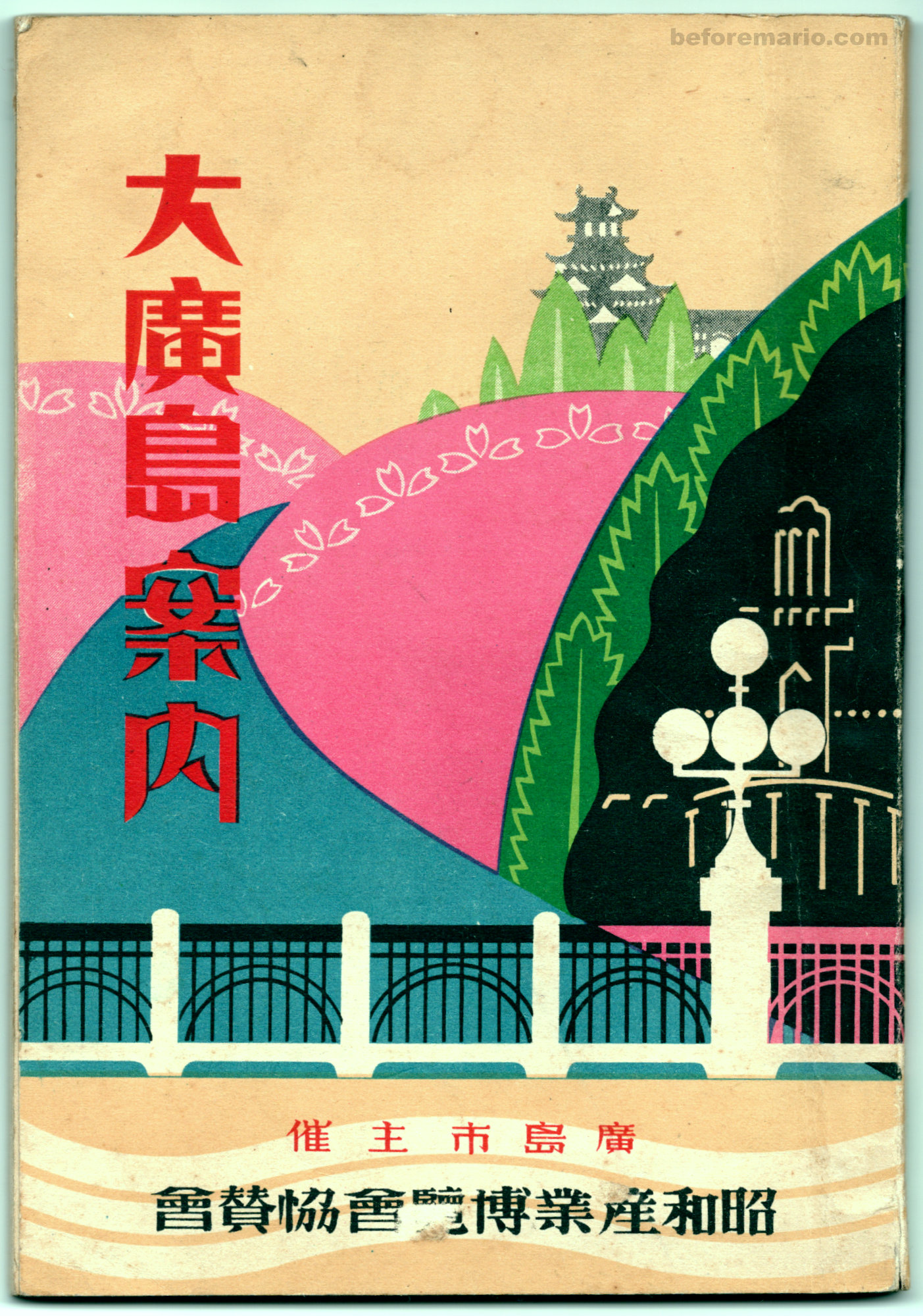
The title is Great Hiroshima Guide (大廣島案内), which is printed in large red kanji on the front.

The sub title reads Showa Industry Expo Conference (昭和產業博覽會恊贊會), which is sponsored by Hiroshima City (廣島市主催).

As an aside, for those of you not familiar with the changes over time to the writing style of Japanese script, this booklet stems from an era when the custom was to write top-to-bottom and right-to-left.

Great Hiroshima Guide (1929) front page

The drawing on the front shows various landmarks of the city of Hiroshima, including Hiroshima Castle.

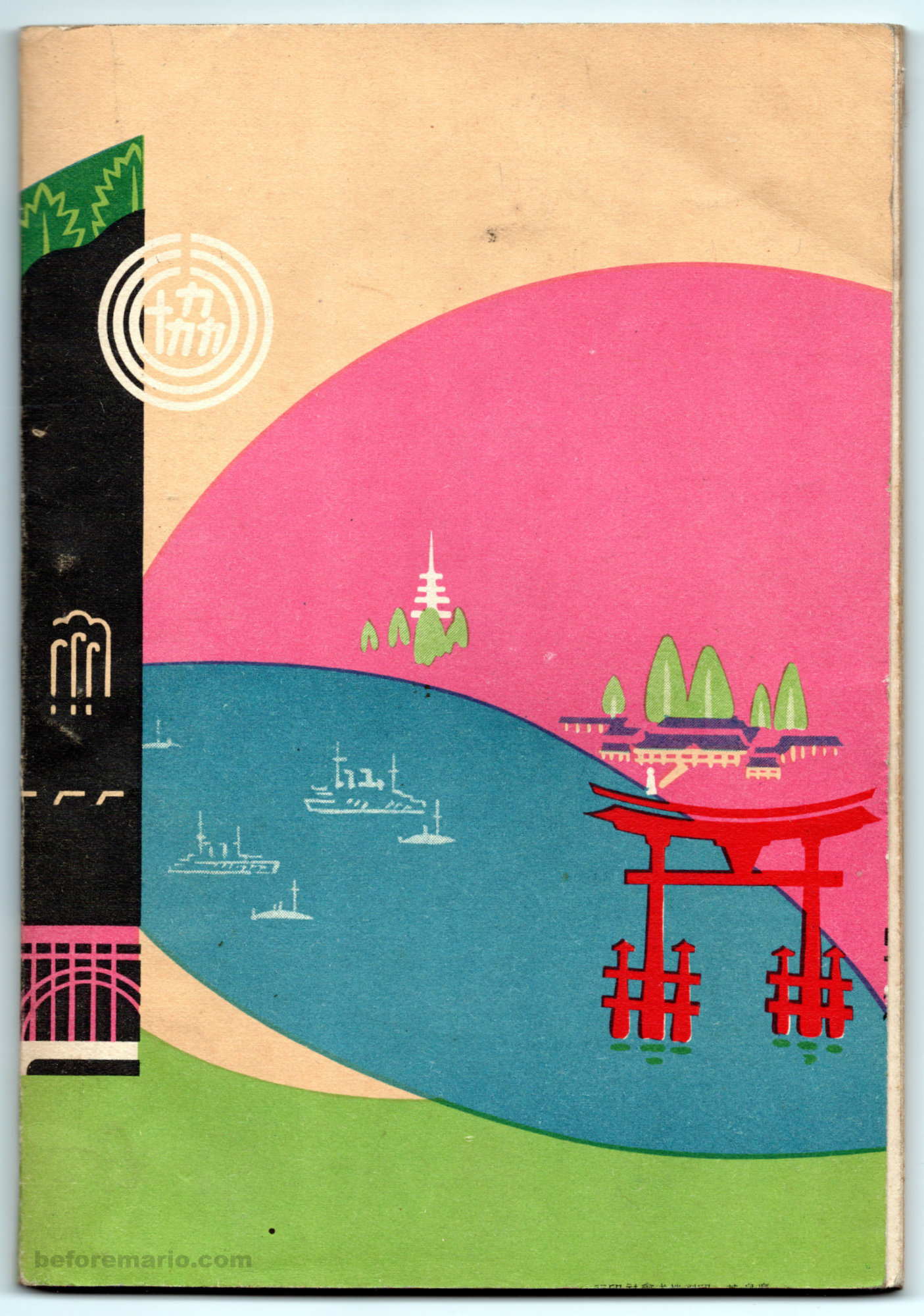
On the back we immediately recognize the Itsukushima shrine, located at the shoreline of the nearby Itsukushima island (also known as Miyajima).


Great Hiroshima Guide (1929) back page

The colofon at the back of the booklet indicates that it was printed in March of 1929. That is 94 years ago!

It also states that the booklet was not for sale (非売品).

The booklet was commissioned by the city of Hiroshima, in cooperation with the "Showa Industry Expo Association" (昭和產業博覽會恊賛會), and presumably handed out for free to (prospective) visitors of the expo.

The publisher and editor was Yakichi Ishikawa (石川彌吉).


Colofon

In the preface, the editor explains that the booklet covers the main attractions ("famous places") of the city of Hiroshima and surroundings, using "as many pictures as possible". Information about shops and products is "provided by advertisements".

Indeed, besides editorial content, more than half of the booklet is filled with advertisements.


Preface

At the front of the booklet, there is a very nice pullout map, printed on one side in color. When pulled out, it measures about 46 centimeters wide.

The front of this map shows a drawn aerial view of the city of Hiroshima, with indication of the tram lines and tram stops as well as the locations of the expo. The back shows a map of the greater Hiroshima area, with all railway connections.

Sunday, October 27, 2024

A Treasure in Kyoto: Rediscovering Nintendo’s First Ad from 1894

Discovering a Rare Find—Twice!

A few weeks ago, on October 2nd, I was in Kyoto, Japan, to visit the newly opened Nintendo Museum.

The day before my museum visit, I was lucky to view a historic document recently uncovered by a fellow researcher: Nintendo’s earliest known advertisement, an astonishing 130 years old.

And a day after the museum visit, the discovery of a second copy of that document was truly remarkable.


The earliest known advertisement by Nintendo, 130 years old

I was visiting Japan with fellow Nintendo historians and enthusiasts Florent Gorges and Fabrice Heilig. The night before the museum opening, we stayed at a special location in Kyoto: Hotel Marufukuro.

This was Nintendo's first stone-built headquarters, now renovated and remodeled as a hotel. On the second floor is a room called the "dNa Library," which houses books and artifacts that tell the story of Nintendo’s history. We are honored to have our books—one by Florent and one by me, with contributions from Fabrice—displayed in this library.

Earlier that day, Fabrice had picked an old book from a Kyoto-based antiquarian bookshop.

The shop owner had contacted Fabrice, who lives in France, a year earlier about this book in his collection but, in the end, wasn’t comfortable selling it over such a distance.

Now that Fabrice was in Kyoto for the museum opening, he seized the opportunity to acquire it in person.

As the proud new owner of this historic find, he shared it with us in the library. There could be no better place for this unveiling than Nintendo's former headquarters, located on the very site where the company was founded back in 1889. Florent recorded a video of this moment, which you can find at the bottom of this post.

While visiting the Nintendo Museum the next day, I spoke with Japanese playing card aficionado Marcus Richert, who knew of a Kyoto bookseller offering a second copy of this rare book.

Barely believing our luck, Florent and I set off the following day to investigate. Finding even one copy was a rare stroke of fortune—but discovering two seemed almost unbelievable.

Saturday, May 16, 2015

Nintendo's birthplace in Kyōto

When visiting Japan a few weeks ago, I took a walk past Nintendo's place of birth in Kyōto, where the company still holds an office at the site where it was established in 1889.

Nintendo means a lot to me, even so much that it inspired me to write a book about its history. Although my visit was limited to the exterior of the building (alas), it is nice to get a feel for the type of neighborhood that the company started in. With some imagination, you can picture in your mind the early days of the playing card business from over a hundred years ago.

Author meets subject

The Nintendo building is situated along Shōmen-dōri (正面通り) [Google map link here] on the eastern part of Kyōto, just west of the famous historical area Gion.

Shōmen-dōri means 'front street', named so because it was the street in front of the Hōkō-ji (方広寺), one of the important temples established in Kyōto in the 16th century. The Hōkō-ji housed Kyōto's great Buddha statue, before this was destroyed, a few times actually, in an earthquake and some fires.

Shōmen-dōri runs west-to-east through the city for about four kilometers, starting near the Tambaguchi Station (丹波口駅) and ending at the Hōkō-ji.


Nintendo was established by Fujisarō Yamauchi as a Hanafuda (flower cards) selling shop and workplace at Shōmen-dōri in the Ohashi area of Kyōto, on September 23 in 1889.


This promotional card from around 1915 lists the Shōmen-dōri address for 'Yamauchi Nintendo' (山内任天堂), the name the company used at the time (written right-to-left in Japanese). This would remain the headquarter address well into the 1950s.

Sunday, May 7, 2023

Nintendo Souvenir Kyoto Playing Cards, at last

This is a story about a very special item in my collection, the Nintendo Souvenir Kyoto Playing Cards.

Nintendo's hometown Kyoto

Kyoto is famous for many things. Before Tokyo, it was the official capital of Japan for over a thousand years, and it is still considered the cultural capital. With hundreds if not thousands of historical sites, it is a major tourist attraction for domestic and foreign visitors.

Kyoto is also the town where Nintendo was founded by Fusajiro Yamauchi, 133 years ago. It has remained the heart of the company's operation to this day.

If you would check Mario's passport, and that of countless other Nintendo creations, you would find Kyoto as the place of birth.

A nice example of the tie between Nintendo and Kyoto is this photo taken at the start of the year in 1949. Nintendo was already sixty years old at the time.

The photo shows a group of (or all?) company employees posing in front of the gate of the Fushimi-inari Shrine, located in the Fushimi ward in the south of Kyoto. This shrine is a popular location to celebrate the start of the new year, one of the most important traditions in Japan.

The gate of this shrine can easily be recognized by the two fox statues standing on either side in front of it.

This photo is a great document of the company at the time. Unfortunately we do not know who all people are that we see here, in their best kimonos and suits. We suspect that the company president at the time, Fusajiro's successor Sekiryo Yamauchi, must be in it. As well as his grandson and future president Hiroshi Yamauchi. But we do not know for sure.

What is undoubtably clear, is that this is a company that is part of the fabric of the city of Kyoto. The two banners on either side of the picture state "Kyoto Nintendo" (京都任天堂).

This connection between Nintendo and Kyoto has remained strong ever since, as is also evident from the images below, taken from a Nintendo company guide from 2012.

Although the company's playfield has become global, Nintendo conducts that business from one place: Kyoto.

Nintendo Souvenir Kyoto Playing Cards

From the moment I first saw the content of the 1950s company report shown below, I have been searching for a particular set of Nintendo playing cards.

This deck, called Souvenir Kyoto Playing Cards, was presented in this document together with many other types of playing cards that Nintendo offered at the time. Of all the products included in this catalogue, this one intrigued me the most.

The concept of playing cards with photos aimed at tourists is not original in itself.