Sunday, March 13, 2011

Nintendo Chiritori (無線クリーナー チリトリー, 1979)

In the early 70s, a series of remote controlled cars had been released by Nintendo (called Lefty RX). These used a rudimentary single-button radio control mechanism, allowing the cars to start and stop. Steering was not an option: the “left” in the name refers to the fact that the front wheels of the cars were fixed going to the left side.

A similar radio control mechanism would be used for another unlikely Nintendo toy designed by Gunpei Yokoi: Chiritori (Japanese for “dustpan”).

Radio controlled cleaner Chiritori (無線クリーナー チリトリー)

The toy was also referred to as "無線クリーナー", which means "radio (controlled) cleaner".

Cover page of the manual

Chiritori was released in 1979, and retailed for ¥5,800. It did not become a big seller and was produced in relatively small numbers, making it one of the rarer Nintendo toys and very difficult to find these days.


Chiritori is a remote controlled, battery operated mini vacuum cleaner. It measures a mere 16 centimeters across, with a small fan providing dust-sucking action. Although it can actually vacuum, this is not intended for serious cleaning. It would take you all day to do a single room.


Chiritori comes with a radio controller with a single button.


Both Chiritori and controller have small antennae for radio communication (using the 40.680 MHz band).


Also included is a sheet of stickers, which can be used to customize the body of Chiritori.

Sticker sheet provided with Chiritori

When switched on by turning the big white button on the top, Chiritori starts spinning in place (always clockwise). Press the button on the remote controller and it stops spinning and moves in a straight line in the direction it was facing when the button was pressed. Release the button on the remote again, and it stops moving forward and reverts back to spinning around. This control system allows Chiritori to be negotiated in any direction, but it is a bit tricky and requires practice.


The front of Chiritori clearly shows the white sucking mouth facing the ground, and the air outlet in the front.

The manual shows how to insert batteries and operate the Chiritori

The Chiritori and radio controller are battery operated. The Chiritori requires 4 C cells and a 9 volt block, the controller uses another 9 volt block.


Now if we flip the Chiritori over, we see the two main wheels used to move and a smaller non-motorized wheel providing additional support.


When the tray that collects the gathered dust is removed, the fan is exposed. This fan sucks up the dirt and drops it in the tray.

I am sure that by now you are dying to see it in action. Sit back and witness the video I made of the awesome cleaning power of the Chiritori!


Chiritori's quirkiness ensured an appearance in the of WarioWare games (WarioWare Inc, GBA, 2003). Check out the video below (by YouTube user oODiAbLoSOo).


As an aside: while writing this post I was plagued by yet another romanization question: I would expect "チリトリー" to be written as "Chiritori" or "Chiritorii", but Nintendo themselves write it as "Chiritorie" in WarioWare. Strange.


Anyway, if you like this post, then also check out this one about the accompanying leaflet.

Saturday, March 12, 2011

Nintendo Ultra Hand (ウルトラ ハンド, 1966)

Around the mid-sixties, Nintendo had established a games department and was producing mostly traditional board games. Some of these were using a recently acquired license to feature Disney Characters as well as Japanese TV figures.

Nintendo was already well known as a card manufactured, but was a small fry in the general toy market when compared to other companies like Epoch and Bandai.

Nintendo needed something to put itself on the map in the toy area, and the first toy designed in 1966 by Gunpei Yokoi provided this much-needed recognition.

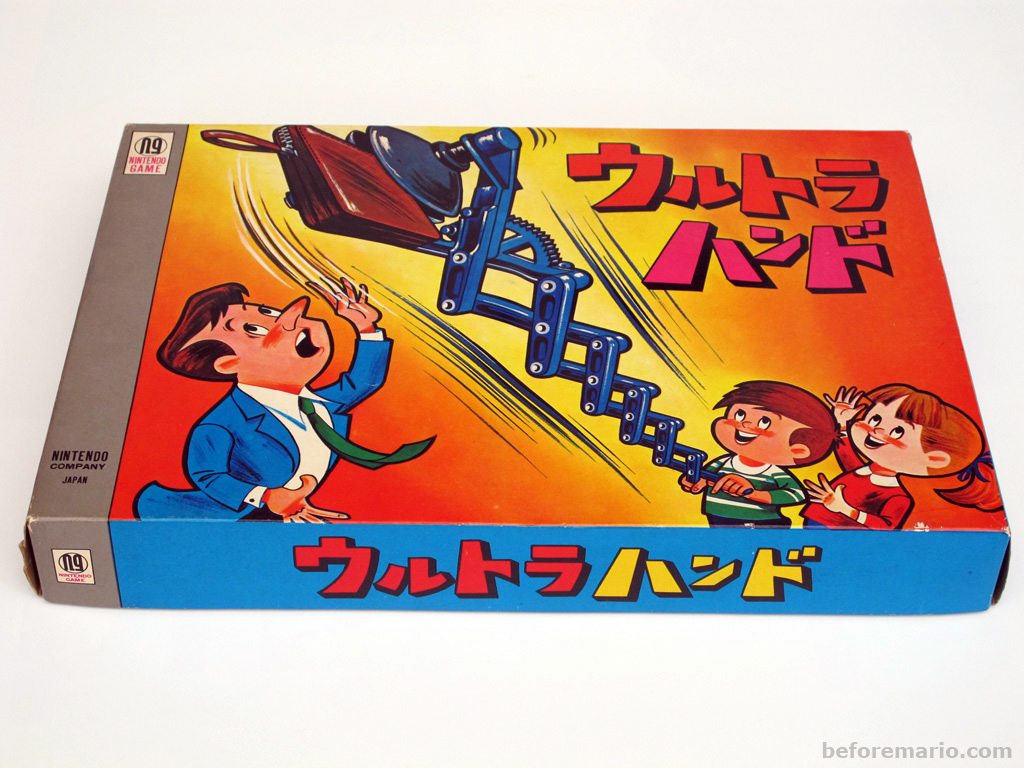
The Ultra Hand

The Ultra Hand - the first Nintendo toy by Gunpei Yokoi

Selling for ¥600, the Ultra Hand (ウルトラ ハンド) was a plastic toy that could be expanded and contracted by moving the handles.


The top of the box contained a drawing with a spectacular display of the fun to be had with this toy.


The toy came with three colored balls with stands, which could be used to practice.


Around the release of the Ultra Hand, Nintendo had not yet found its final corporate identity, and the logo still changed regularly. The Ultra Hand was released under the "Nintendo Game" brand; with the "NG" logo.


Besides the box, the toy also contains some further Nintendo branding.

The Nintendo name is stamped on the small weight that keeps the cord straight

The Nintendo name can also be found on the toy itself

Operating the toy is pretty much straightforward, though grasping an item in the claws requires some practice.

Instructions in the Ultra Hand manual

As explained in the manual, the “hands” at the end of the Ultra Hand could be closed to grab an item, by pulling the red string.


The Ultra Hand became a great success and more than a million were sold between 1966 and 1970, making it Nintendo’s first million seller.

The manual shows a happy 60s family

Box Versions

At least 5 different versions of the box design have been released in Japan over the years. Besides the three pictured below, a blue variant of the white box exist, as well as a design with the newer NG logo and a photo on the front.

The Ultra Hand has been released in different box designs


There are also some differences in the interior of the boxes. The nicest versions have silvery lining which provides a more luxurious and futuristic feel.


The white box reuses some of the art from the previous versions and introduces a new Ultra Hand logo on the side of the box.


Note the copyright: (c) 1966 by Nintendo

The white box has an alternative cover for the manual.


The blue box is a simliar to the white one, except for the background color.


This version does include an instruction booklet. Instead the instructions are printed on the inside of the box lid.


The rarest box is the one pictured below. This version from 1973 is the last incarnation of the Ultra Hand packaging. By this time the Ultra Hand's novelty had worn off, and sales slowed down. This would explain why it is almost impossible to find one of these remaining today.


Seven years after it's introduction, the price of the Ultra Hand had doubled from ¥600 to ¥1,200, as can be seen in this advert from a 1973 Nintendo brochure. [More on this version in this post.]


The Ultra Hand abroad

A final box variant is this Ultra Hand version released for the Australian market by an Australian company named "Hong Kong Handarts". Although the box does not mention this as an officially licensed product, the Ultra hand inside was produced by Nintendo.

This must be one of the first Nintendo toys to make it out of Japan. Until the 80s Nintendo did not distribute their own products internationally, but worked with international partners. However, until the release of the Ten Billion puzzle and Game & Watch, the items that were made available abroad were limited and the volumes low.

Ultra Hand sold in Australia by "Hong Kong Handarts"

The box art was changed using some local inspiration.


Swiping a baby kangaroo out of its mothers pouch may not be advisable in real live, but here it sure looks fun.

Grill-Off with Ultra Hand!

Recently, the Ultra Hand has been featured in a WiiWare game called “Grill-Off with Ultra Hand!” available to Club Nintendo members in Japan and the USA.


In this game the Wii Remote and Nunchuk are used to simulate the handles of the Ultra hand.

2024 update! Nintendo release a remake of the Ultra Hand, available for sale at the newly-opned Nintendo Museum. More info here.

Tuesday, March 8, 2011

Nintendo Key Figures - Gunpei Yokoi (横井軍平)

Although Nintendo gradually but steadily amassed a large staff of talented designers and engineers, one name stands above the rest in terms of influence and impact on the company in the period from the 1960s to the 1980s: Gunpei Yokoi.

Originally a maintenance engineer on Nintendo’s hanafuda card manufacturing line, his talent was soon spotted by then Nintendo chairman Hiroshi Yamauchi, and put to use in the games department.

He single-handedly created many of the toys and games featured on this blog.

An inventor by nature, he was always looking for new ideas and new uses of technology., and continued to play a very important role, developing Game & Watch and – his masterpiece – the Game Boy. He was also involved in software development, producing games including Metroid and Super Mario Land.

The Game Boy is a true testament to his design philosophy: much more important than using a cutting edge (and power consuming) colour screen (it hadn’t) were long battery life and low production cost (it had): creating a true handheld for the masses.

Yokoi left Nintendo in 1996, after 30 years of employment. He started Koto Laboratory, which was involved in the design of the WonderSwan for Bandai.

His departure at Nintendo is often linked to the commercial failure of the Virtual Boy (another of his inventions). However, Yokoi himself has stated that he resigned to find a new working environment similar to the smaller Nintendo of the past, and that he even stayed on longer than he had planned, as he wanted to leave on a high note. His last project at Nintendo was the redesign of the Game Boy, which resulted in the hugely successful Game Boy Pocket.

Yokoi died in a car accident in 1997, aged only 56.

[A post about Yokoi's time at Koto Laboratory can be found here.]


If you want to find out more about the life and inventions of Gunpei Yokoi, I recommend the biography by Takefumi Makino (牧野 武文).

Gunpei Yokoi biography by Takefumi Makino

The original Japanese version is available (ISBN: 978-4-04-885058-2) from, amongst others, amazon.co.jp. The title is: "ゲームの父・横井軍平伝 任天堂のDNAを創造した男", which translates to "Father of Games - Gunpei Yokoi the man who created Nintendo's DNA".

"Gunpei Yokoi - Vie et philosophie du dieu des jouets Nintendo"

The Japanese version has been translated into French by Florent Gorges (ISBN 978-2-918272-18-1). It can be ordered online from Pix 'N Love Editions. No English translation is available at this time.

Saturday, March 5, 2011

Nintendo Love Tester (ラブテスター) remakes by Taito (2008) and Tenyo (2010)

In 1969 Nintendo released the Love Tester (ラブテスター). It was one of the earliest electronic toys, as well as the first step on the path of electronic entertainment by engineer and inventor Gunpei Yokoi. A path which would eventually include Game & Watch, Gameboy and WonderSwan, to name a few.

In recent years, two remakes of the the Love Tester have become available. Although this blog normally only features vintage toys, today we will take a small sidestep and look at these new versions of this toy from the late 60s. This will also give us an opportunity to take a closer look at the original toy.

The Love Tester remakes by Taito (left) and Tenyo (right)

Each of the two remakes takes a completely different approach. One has translated the concept of the original toy into a modern version, while the other tries to stay as close as possible to the original. Although not produced by Nintendo, they are both officially licensed.

The box of the Love Tester by Taito has a retro-ish feel to it

The Taito version of the Love Tester (2008) was a Ufo Catcher prize. The Ufo Catcher is the Japanese version of the Crane Game or Claw Crane you can see in arcades around the world. Taito is one of the big names in this area; they operate arcades and produce Ufo Catcher machines and prices.

"Prize Only": it could only be won in Ufo Catchers in Japanese arcades

This version of the Love Tester could only be won in arcades in Japan. Although it was never officially for sale, a thriving market exists for Ufo Catcher toys. It is not so hard to come by, even if you did not want to depend on luck and skill (and a good supply of 100 yen coins) to pry it from the machine.

Taito Love Tester remake (2008)

The Taito Love Tester is a modern recreation of the original toy in name and concept only. Regarding the design and looks, corners have been cut to keep the production cost low. The two external leads with the "knobs" you hold in your hands have been replaced by two sensors on the device, and the "love" meter is represented by five colored LEDs.

It is nice to see this kind of tribute appear in the arcade, but all in all it looks a bit cheap.

Tenyo (テンヨー), a Japanese company big in novelty items, took an entirely diffrent approach in 2010. They lovingly and painstakingly recreated the Love Tester in such a way that at first glance original and remake are hard to distinguish. Both the box and the actual toy are very good copies of the original.

Nintendo Love Tester (left, 1969) and Tenyo remake (right, 2010)

On the front of the box of the remake, only a small note on the top left corner gives it away.

Nintendo Love Tester (left) and Tenyo remake (right)

Flipping the boxes over, the difference between the two becomes more noticeable. The back of the remake box contains the kind of health and safety warnings people these days cannot survive without (do not eat this toy, do not feed it to your pet, etc). I am not sure how they managed to stay alive in the 60s.


On the back we also see the Tenyo company logo and the Nintendo copyright notice (1969-2010).

Nintendo Love Tester (left) and Tenyo remake (right)

Opening the old and new boxes side by side, it becomes even more clear what a nice job Tenyo has done with this remake.

Love Tester remake by Tenyo

This remake of the Love Tester looks very similar to its forty-year-old predecessor. The only difference we can immediately see is the use of rubber bands instead of the silver clips to keep the wires together.

Nintendo Love Tester (left) and Tenyo remake (right)

The back of the toys does not reveal any real differences until closer inspection.

The original Love Tester was "made in Japan"

The original Love Tester contains a "made in japan" note on the back. Japan in those days was still known for cheap electronics.

As most Japanese toys these days, the Tenyo remake is "made in China"

Forty years on, and Japanese companies have moved a large part of their production to China, as is also evident from this toy.

Nintendo Love Tester (left) and Tenyo remake (right)

Another sign of the time is the impact of changing safely regulations, which becomes clear when the back lid is removed to change the battery. In the old version the electronics are exposed, while in the new version they are neatly tucked away behind extra plastic shielding.

Nintendo Love Tester (left) and Tenyo remake (right)

When the additional shielding of the new version is removed and the electronics of old and new are placed side by side, another difference can be seen: although the electronic components used by both versions are virtually identical, the 1969 version did not yet use printed circuit board, which was not yet very common at the time.

The sensor "knobs" of Nintendo Love Tester (left) and Tenyo remake (right)

The wires leading to the sensor "knobs" in the new version also contain some additional protection at the spot where they enter the metal cups. The construction used by the original is probably considered a safety hazard these days.

Pouches of Nintendo Love Tester (left) and Tenyo remake (right)

Just like the original, the Tenyo remake contains a carry pouch to store the Love Tester when taking it on the road. Like the toy these are also very similar, except for the zipper (silver for the original, black for the remake).

All things considered, Tenyo has to be applauded for creating this quality replica. It is sold through their Japanese online shop, but can also be obtained through various Western sites selling Japanese items.

By the way, the Love Tester wasn't the only Nintendo re-release by Tenyo, as they also brought out a remake of the Ultra Machine.