In 1967 Nintendo released the Ultra Machine, one of their successful entries in the toy market in Japan.
At the time Nintendo was still focusing for the most part on their home turf. However, they were trying to get a foot in the door in foreign markets as well. Nintendo first started exporting playing cards, and soon also experimented with the export of some of their toys (see for example the Australian version of the Ultra Hand).
The Ultra Machine was a logical candidate for export, given the huge sales success in Japan and its internationally appealing game theme. The "Ultra" moniker was big in Japan, but not much so outside of it, so a different name was given for the foreign release: Slugger Mate.
The Nintendo Slugger Mate (re-branded Ultra Machine)
For most people outside of japan who came across this toy, it would have been their introduction to the Nintendo name.
1967 - first small steps by Nintendo in becoming a global household name
The box lists "copyright 1967 by Nintendo". This reflects the year of introduction of the Ultra Machine in Japan, however it is unclear if the Slugger Mate was released in the same year or some time thereafter.
Not much is known at this time regarding the geographical spread of this release. They have popped up in Australia and in the US as well, so it is currently believed those were the main areas of sales. The instructions provided with the Slugger Mate are also English only.
The packaging is identical to the home release, except for the name change.
A "made in japan" message was added to the box, possibly to set it apart from (cheaper quality) toys from Hong Kong. At the time, Hong Kong had become of one Japans biggest export rivals for toys and electronics.
The toy itself is identical to the home release, except for the sticker on the front.
Nintendo Slugger Mate (re-branded Ultra Machine)
Judging by the small numbers of Slugger Mate's that have surfaced in collectors' circles, we can safely assume that this international release only generated modest success, at best. It would be until 1980, and a little game called Game & Watch, that the foreign adventures of Nintendo would finally pay off in a big way.
In 1967 Nintendo released the Ultra Machine. This baseball ball pitching toy would remain a good seller for many years.
After a period of ten years, in which the original Ultra Machine continued to sell, Nintendo decided it was time for a redesign of this Gunpei Yokoi classic.
In 1977, a new version called Ultra Machine DX was introduced, which was short for Ultra Machine Deluxe (ウルトラ マシン デラックス). "Ultra" as well as "Deluxe" - pretty strong accolades for a plastic toy.
Nintendo Ultra Machine DX (1977)
The game was sold with the slogan "Take the challenge to become a home-run king" (ホームラン王にチャレンジしょう), and the box featured pictures famous sluggers from Tokyo (Yomiuri) Giants and Osaka (Hanshin) Tigers.
This will help you to become a Homerun King (ホームラン王)
The retail price was set at ¥2,800.
Nintendo Ultra Machine DX (1977)
Opening the box, one may wonder why this version of the Ultra Machine is called "Deluxe", as the packaging is a lot simplified compared to the original version, ditching the plastic inner support structure.
Instruction can be found on the inside of the box
The package contains the Ultra Machine DX itself, the familiar retractable plastic bat and ten plastic balls. Instructions can be found on the inside of the box lid. The bat is the same (color and size) as the 1974 version of the original Ultra Machine.
Nintendo Ultra Machine DX (1977)
The new version had a more contemporary rounded look, taking the somewhat clunky 60s version well and good into the 70s and early 80s.
Ultra Machine (1967) and Ultra Machine DX (1977)
Placing the original Ultra Machine and new Ultra Machine DX side-by-side shows the difference in size. The new version is significantly bigger and the balls have grown in size with it (from 3.8 cm to 4.5 cm in diameter). The pitching arm of the DX is also proportionally longer, allowing the bigger balls to be delivered with just as much oomph.
The design is accomplished and the curves portray a feeling of speed.
Operation of the toy is identical to the original Ultra Machine: insert a single D cell, set the spring to the desired angle, switch on the machine and start batting as the balls are lugged at you automatically one by one.
Although the Ultra Machine DX was only sold in Japan, an U.S. patent number (3511225) is shown next to the Nintendo copyright sign at the base of the toy. Japanese patent numbers (954238 and 954259) and design number (303513) are printed on the box.
The base of the game shows a copyright notice and U.S. patent number
Over the years, a number of different boxes have been released for the Ultra Machine DX.
Two of the multiple box variants of Ultra Machine DX
The Ultra Machine homage featured in the "Wario Ware, Inc" Gameboy Advance game is based on the Ultra Machine DX, though the sharp observer will notice the bat used is the blue-yellow one from the original Ultra Machine.
The year 1977 marks an historic moment for Nintendo, as it is the year in which they created the first video game for home use; aptly called Color TV-Game 6 and Color TV-Game 15, they are the first two machines in the Color TV-Game series.
Though commercially successful, and thus providing the incentive to continue in this business direction, the release of Color TV-Game 6 and Color TV-Game 15 was a modest first step in the sense that the game ideas did not originate from Nintendo itself. A license to produce these pong-style games was obtained from Magnavox. Technical expertise needed to manufacture these machines was obtained through a partnership with Mitsubishi Electronic.
Nintendo Color TV-Game 6 (1977)
Clearly sprouting from the TV tennis family-tree, which started with the Magnavox Odyssey and was turned into a household name ("Pong") by Atari, Color TV-Game 6 (カラー テレビゲーム 6) is a dedicated game console that offers six variants on the bat-a-light-blip-from-left-to-right-and-back-again type of game play.
Though not very original, the Color TV-Game 6 provided exactly what the public was looking for at the time, in a quality package, for the right price.
(Video uploaded by YouTube user mushmaster)
The retail price of ¥9,800 for the Color TV-Game 6 was very appealing, as all competitive offers at the time sported much higher price tags. This was a big factor in the success of Color TV-Game 6.
The first video game to bear the Nintendo brand name
The Color TV-Game 6 actually offers only three different game types. But each of these can be played in two different modes, which brings the total to six games.
The three game types are hockey (ホッケー), volley ball (バレーボール) and tennis (テニス). Each of these can be played in singles mode (シングルス) or doubles mode (ダブルズ).
The six game variants are described on the side of the box
All six games are two player games. Each player operates one of the two controllers (analog paddles) attached to the Color TV-Game 6. In singles mode each player controls a single "racket" on screen. In doubles mode each player controls two "rackets" simultaneously.
Throughout 1977, four versions of the Color TV-Game 6 were released, although there are only two truly different variants. Furthermore, one isn't an actual Nintendo product, but was released by Sharp as we will see below.
The bottom game is the CTG-6S, others are CTG-6V variants
The first release of Color TV-Game 6 can be recognized by its off-white color housing and box. It listens to the name CTG-6S.
The original Color TV-Game 6 (CTG-6S)
Manual of the Color TV-Game 6 version CTG-6S
Soon after the release of the CTG-6S, an improved version of the Color TV-Game 6 named CTG-6V was released. This second version was produced in much larger quantities, and, as a result, is much more common today.
Manual of the Color TV-Game 6 version CTG-6V
The game-play of CTG-6S and CTG-6V versions is identical, but there are some physical differences between the two machines. The most obvious is the color of the housing; the off-white being replaced by bright orange.
The second release of Color TV-Game 6 (CTG-6V)
If we place them side-by-side, it becomes also immediately apparent that the controllers of the CTG-6V are bigger than those of its predecessor, offering a better grip.
Another improvement related to the controllers is the introduction of a "stop" at the top and the bottom of the screen. The controller of the original CTG-6S could be turned endlessly; when the "racket" disappeared at the bottom or top of the screen, it would reappear at the other end, making it hard to position the racket during frantic play. With the new CTG-6V, the "racket" comes to a stop at the top and bottom borders of the screen, providing a more realistic interpretation of the tennis game.
Color TV-Game 6 CTG-6S (bottom) and CTG-6V (top)
Another difference between CTG-6S and CTG-6V is the way the system can be powered. The machines require 9V DC, which can be provided by placing 6 C cells in the battery compartment at the bottom.
"Feed me" this battery compartment says
For the CTG-6S, using batteries is the only option. The CTG-6V introduces the option to use a power adapter instead, for which a connector is included in the back. A dedicated power adapter (model CTGA-901A) was separately available for ¥1,500. This adapter was compatible with all other Color TV-Games.
A sight that makes the Energizer Bunnies cry: the power adapter connector of the CTG-6V
The Color TV-Game 6 does not feature the Nintendo name on its housing, using "Color TV-Game" as its brand identify. The manual and box include the Nintendo name, but not very prominent.
Besides the six game variants, the game-play can be influenced with some additional settings that change the size of the players "rackets" as well as the level of acceleration of the ball when it hits the "racket".
The switches used to select game type, game mode and some other options
The four switches at the top of the control panel are: racket size of left and right player (up is small, down is big), speed after bounce on the racket (up is high, down is low) and game mode selection (up is doubles, down is singles).
The three switches at the bottom of the control panel are: power switch (up is on, down is off), reset button and game type selection (volley ball, tennis, hockey).
Maybe they work for some people, but I find the diagrams in the manual explaining the various types of game-play quite confusing. They remind me of text books on nuclear physics.
Game-play explained or Feynman diagrams?
A special version of the Color TV-Game 6 was produced for food company House Foods to promote their instant noodles product House Shanmen (ハウスシャンメン). Instant noodles? Yes, instant noodles.
The rare House Shanmen version of Color TV-Game 6
The House Shanmen version of Color TV-Game 6 is identical to the regular CTG-6V, except for the metal name plate on the top, which in this case shows the noodles brand name.
A closer look at the rare House Shanmen version of the Color TV-Game 6
I reckon a lot of instant noodles had to be consumed before one became eligible for this machine. They are quite rare and difficult to find these days.
"Thank you for buying this many noodles"
Another interesting variant of the Color TV-Game 6 are the versions licensed to Sharp. Sharp produced TVs and bought licenses for video game consoles to sell with their TV sets.
Sharp would continue to license Nintendo's subsequent systems: Famicom (Sharp Famicom Titler AN510 and 14C-C1F and 19C-C1F TVs), Famicom Disk System (Sharp Twin Famicom AN-500R, AN-500B, AN-505-BK and AN-505-RD) and Super Famicom (Sharp 14G-SF1 and 21G-SF1 TVs).
One of the two Sharp licensed versions of the Color TV-Game 6
As is the case for Nintendo's own model, there are two versions of the Sharp's licensed Color TV-Game 6. There is a version based on CTG-6S as well as one based on the CTG-6V. The Sharp product codes are, respectively, XG-106 and XG-106V. Both are identical to their Nintendo counterpart, except for the different color housing (which is a darker orange) and the Sharp branding on box and console. They also are simply called Color TV-Game, dropping the "6" from the name.
The manual of a Sharp version of Color TV-Game 6
The Color TV-Game 6 and Color TV-Game 15 were the first time people connected a Nintendo produced "box" to their TV set to play some games. We now know it wouldn't be the last time. Almost thirty-five years and multiple generations of ever improving, multi-million selling Nintendo video game consoles on, we can reflect on this moment as the beginning of something very, very big.
Four different guns and rifles exist in the Nintendo Kôsenjû light beam series. In this post we will shed some light on their differences, in particular the compatibility between guns and rifles and the various targets.
The four Kôsenjû guns and rifles
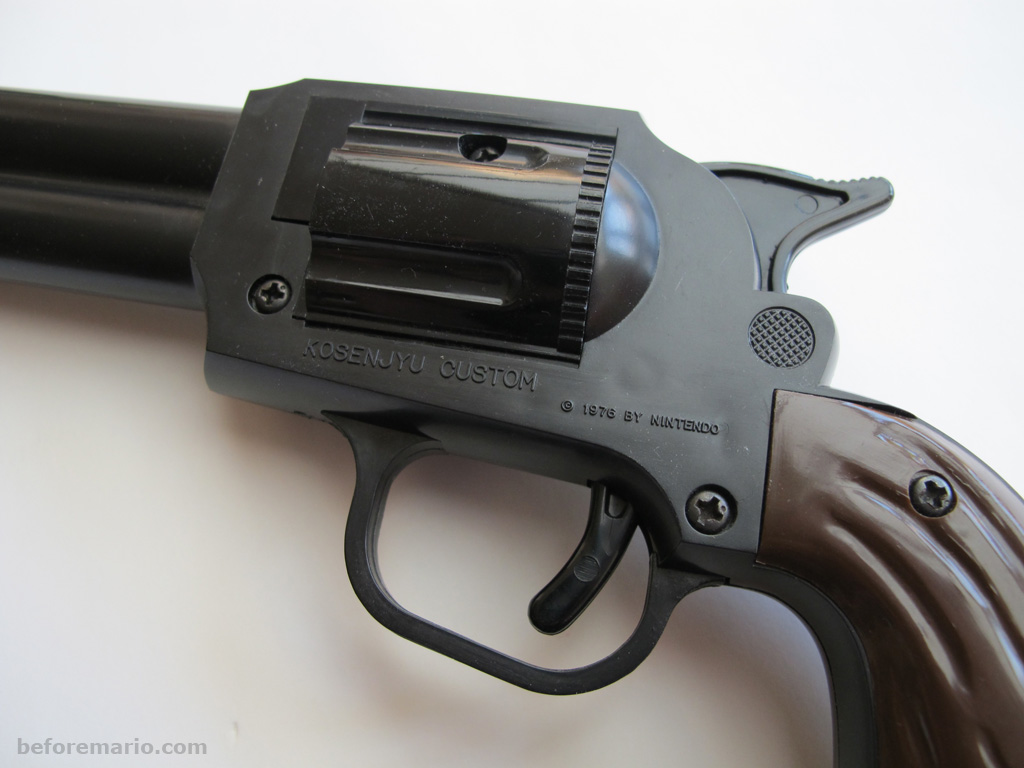
In the image above, we see from top to bottom: Kôsenjû SP Rifle (光線銃SP ライフル, 1970), Kôsenjû SP Gun (光線銃SP ガン, 1970), Kôsenjû Custom Action Lever Rifle (光線銃 カスタム レバーアクション ライフル, 1971) and Kôsenjû Custom Gun (光線銃 カスタム ガン, 1976).
The Kôsenjû SP and Kôsenjû Custom guns are similar in size and design. The main exterior differences are the color of the handle and the trigger mechanism. Furthermore, the light source of the Kôsenjû Custom Gun is more focused and stronger than that of the Kôsenjû SP Gun, which improves the range of the gun.
The Kôsenjû SP Gun has a white handle and a metal trigger and hammer.
Kôsenjû SP Gun
The Kôsenjû Custom Gun has a brown handle and a plastic trigger and hammer.
Kôsenjû Custom Gun
The two rifles are quite different. The Kôsenjû SP Rifle is smaller and much lighter than the Kôsenjû Custom Lever Action Rifle. It is a real toy rifle, and also a lot cheaper than the Kôsenjû Custom Lever Action Rifle. The Kôsenjû Custom Lever Action Rifle on the other hand, is very close to a real riffle. Like the Kôsenjû Custom Gun, it has a better light source and greater range.
The Kôsenjû SP Rifle is prepared for firing by pumping the handle bar underneath the barrel. It came with a small toy telescope sight, with plastic lenses.
Kôsenjû SP Rifle
The Kôsenjû Custom Lever Action Rifle is loaded by moving the lever underneath the trigger. A professional telescope sight (Custom Lever Action Rifle Scope) with real glass lenses was available as an accessory.
Kôsenjû Custom Lever Action Rifle
Because of the different light sources in these guns and rifles, they are not fully compatible with all available Kôsenjû targets.
Leaflet included with Custom Gunman/Lion explains you cannot use SP Gun and Riffle
In particular, the Kôsenjû SP Gun and Rifle cannot be used with Custom Gunman and Custom Lion, as explained by the leaflet pictured above. The leaflet explains that for these targets the Custom (Lever Action) Rifle or Custom Gun should be used. Interestingly, the price for the rifle is quoted as ¥5,000 in 1976, significantly lower than the 1971 introduction price of ¥14,000.
Compatibility diagram included in the Custom Gunman manual
The compatibility diagram pictured in the Custom Gunman manual also shows which rifle and gun can be used with which target.
Kôsenjû Custom Target with focus lens attached to the sensor in the middle
The Kôsenjû SP Gun and Rifle can be used for the 1971 Kôsenjû Custom Target, if the focus lens which came with the target is attached to its light sensor. The tag attached to the Kôsenjû Custom Target shows its backward compatibility with the Kôsenjû SP series.
The Kôsenjû Custom Target also sports the SP label
This compatibility stuff may sound more complicated than it actually is. Just take a look at the table presented below, which summarizes it all.
Custom Gunman and Custom Lion require a Custom Gun or Custom Rifle